
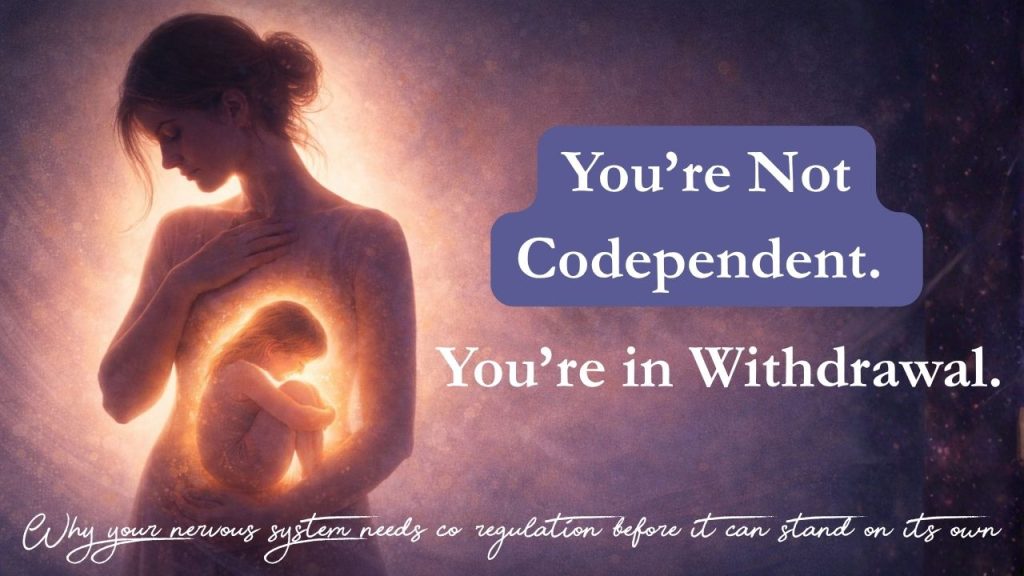
Why your nervous system needs co-regulation before it can stand on its own
By Joanne Yanke. April 6 2026
What if what you’ve been calling codependency…
isn’t weakness at all?
What if it’s your nervous system in withdrawal
from something it never fully received?
One area of my education is Infant Sleep Education, where I work from a deep understanding of developmental psychology and neuroscience.
Our culture tells us we need to be independent.
To self-soothe.
To not “need” others.
But that couldn’t be further from the truth.
We are missing something essential.
Something biological.
Something developmental.
We Learn Regulation Through Relationship
No one comes into this world self-regulated.
A baby cannot calm itself.
A child cannot process overwhelming emotions alone.
We learn safety, calm, and regulation through another nervous system.
Through:
- being held
- being soothed
- being responded to
- being met
This is called co-regulation.
And over time, through consistent experiences of being met…
that external regulation becomes internal.
“We don’t start regulated.
We become regulated through relationship.”
Babies and children left to cry alone don’t learn to self-soothe.
They learn to shut down and not feel.
What Happens When That’s Missing
If consistent co-regulation wasn’t available—
if support was:
- inconsistent
- absent
- conditional
- or overwhelming
then the body adapts.
It learns:
- to over-function
- to hold everything alone
- to suppress needs
- to seek regulation externally later in life
This is where patterns like:
- codependency
- overgiving
- attachment to intensity
- fear of being alone
begin to form.
Not because something is wrong with you…
but because your system is still trying to complete a process that was never fully finished.
When Healing Becomes Withdrawal
This is the part people don’t talk about.
When you stop outsourcing your regulation…
it doesn’t feel empowering at first.
It feels like withdrawal.
I have been a serial codependent.
Jumping from one relationship to the next.
Staying in unhealthy ones just to not be alone.
I’ve been out of my marriage for a year.
And trying to be on my own without a man to hold me felt like:
- my nervous system on fire, like I was standing on the edge of a cliff
- full-blown panic
- dysregulation and insomnia
- intense physical cravings to be held, desired, chosen
So I did what my system knew how to do.
I relapsed into connection.
Not because I was weak.
But because:
I had never wired the ability to self-soothe.
I would find men.
Not consciously thinking “I need regulation”—
but feeling:
- desire
- connection
- closeness
And underneath that…
“relief”
Relief from:
- the emptiness
- the fear
- the instability of being alone
This Is Not Failure — It’s Physiology
We don’t break patterns by willpower.
We break them by:
“building new capacity”
And I had to face a hard truth:
“Trying to do this alone wasn’t working.”
The Missing Piece: Maternal Co-Regulation
What I actually needed wasn’t another romantic connection.
It was something much deeper.
Something earlier.
Something my system had been seeking all along:
“consistent, safe, maternal co-regulation”
Not intensity.
Not desire.
Not chemistry.
But:
- steadiness
- presence
- attunement
- non-demanding support
The kind of support that says:
“You don’t have to perform to be held.”
That’s when everything started to shift.
Why I Needed a “Sponsor”
At one point, I realized something I couldn’t ignore:
This wasn’t just a pattern.
It was an addiction loop in my nervous system.
A physiological addiction to external regulation.
Without it, I was in withdrawal.
Always reaching for something outside of me
to regulate what I couldn’t yet hold inside myself.
For me, that looked like:
- seeking men to desire me
- craving closeness when I felt unstable
- using connection to soothe fear, emptiness, and overwhelm
And when I tried to stop?
It didn’t feel empowering.
It felt like:
- withdrawal
- panic
- restlessness
- a deep, almost unbearable urge to reach for relief
Because that’s what was happening.
I was withdrawing from my primary regulation source.
And this is where I finally understood something profound:
You don’t overcome an addiction by white-knuckling it alone.
In recovery models, there’s a reason people have sponsors.
Not because they’re weak.
But because:
when your system is dysregulated,
you cannot think your way back to safety.
You need:
- someone steady
- someone consistent
- someone who can hold presence
when you can’t hold it for yourself yet
Not to depend on forever—
but to help your system experience stability while it learns to generate it internally.
That’s what I was missing when I tried to do this alone.
I wasn’t lacking discipline.
I was lacking:
support during withdrawal from external regulation.
So I kept relapsing.
Not because I didn’t “want it enough”—
but because my body didn’t yet know another way.
Now, I have support.
Not a replacement for myself—
but a bridge.
Someone who helps me stay when everything in me wants to run.
Someone who reminds my system:
“You’re safe. You don’t need to reach outward right now.”
And from that place…
I’m not just resisting old patterns.
I’m rewiring them.
The Difference This Time
This time, I’m not trying to prove I can do it alone.
I’m allowing myself to be supported
while I learn to stand.
Because healing isn’t about isolation.
It’s about:
receiving the right kind of support
at the right time
so you can eventually become that support for yourself.
Right now, my work isn’t about finding love.
It’s about becoming someone who can:
- feel the urge to reach outward… and stay
- feel the emptiness… and not fill it immediately
- feel desire… without acting on it to regulate
It’s messy.
Some days I:
- cry
- feel fear
- want to run back into someone’s arms
And other moments…
I feel something new:
“a quiet, growing capacity to be with myself”
This Is Re-Parenting in Real Time
This work is:
- not pretty
- not linear
- not something you master overnight
It’s:
“giving your body the experience it missed…
while learning to generate it from within”
The Truth I’m Learning
I am not learning to be alone.
I am learning:
to rewire the dysregulated circuits into ones that can hold me from within.
And paradoxically:
“I needed to be held by someone safe…
in order to learn how to do that”
Final Reflection
If you find yourself:
- craving connection intensely
- struggling to be alone
- going back to relationships even when you know they’re not right
You’re not broken.
You’re not weak.
You might just be:
“in withdrawal from external regulation…
without yet having internal support fully built”
And the path forward isn’t isolation.
It’s:
“safe support + conscious integration”
“We borrow regulation…
until we become it.”
And sometimes…
we need someone to walk beside us
while we learn how to walk on our own.
BodyTalk gave me the awareness.
It gave me the language.
It gave me the tools.
But I was still trying to hold it all on my own.
And that was the missing piece.
I didn’t need more insight.
I needed a consistent container.
I needed to be met.
Repeatedly.
Steadily.
Without having to earn it.
That’s what allowed something in my system to finally begin to soften…
and rewire.
If you see yourself in this—
in the craving,
the pull toward connection,
the inability to just “be alone” without it feeling like withdrawal—
there is nothing wrong with you.
You are not broken.
You are likely navigating a nervous system
that never fully learned how to feel held from within.
And that doesn’t get solved by trying harder.
It gets supported into change.
Sometimes what we need isn’t more discipline.
It’s the right kind of support,
held consistently over time,
so the body can finally learn a different way.
That is the work I hold space for.
Not fixing you.
Not completing you.
But walking beside you
as your system learns how to hold itself.
If you feel that resonance in your body reading this…
you’ll know.
And you don’t have to do it alone this time.
I know what it is to have that one person who can co-regulate you until you’re re-patterned enough to do it on your own, which is why I have a package for this level of consistent care for others.
Need a sponsor?
I got you.