
Why movement, space, and prenatal preparation matter more than pushing harder.
By Joanne Yanke, BodyTalk Birthkeeper
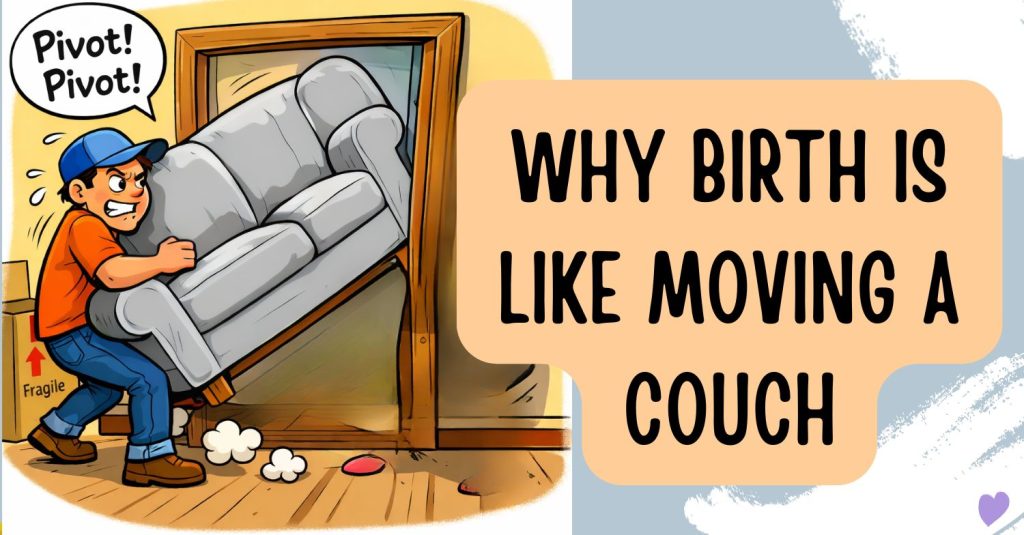
If you’ve ever tried to move a couch through a doorway, you already understand a key concept in birth biomechanics.
Imagine you’re carrying a large couch into a house. You reach the doorway and it doesn’t fit. The couch is too wide for the opening.
What do you do?
Most people don’t push harder.
Instead, they instinctively start to change the angle.
You might tilt the couch.
Rotate it slightly.
Move one corner through first.
Pivot slowly until it finds the angle that fits.
Eventually the couch slides through the doorway—not because you pushed harder, but because you changed the orientation.
Birth works in a very similar way.
The Pelvis Has “Doorways”
During labour, a baby moves through three main levels of the pelvis. Each level has a slightly different shape and requires a different movement strategy.
You can think of these levels like doorways in a house.
The first doorway is the pelvic inlet, where baby first enters the pelvis.
The second is the mid-pelvis, the narrowest level, where baby rotates around the sit bones. It’s moving into and through the hallway.
The final doorway is the pelvic outlet, where baby emerges.
At each level, the baby isn’t just moving downward. The baby is also rotating, flexing, and adjusting to navigate the available space.
Of course, there’s one big difference between a couch and a baby.
A couch is rigid. A baby is adaptable.
A baby’s skull is made of several bones connected by flexible sutures. During labor, these bones can shift and overlap slightly, allowing the head to change shape as it navigates the pelvis.
So while movement helps change the angle of the doorway, the baby is also actively adapting to the space available.
When Labour Slows Down
Sometimes labour slows or seems to stall.
It can be tempting to assume the body just needs to push harder.
But sometimes the issue isn’t force.
Sometimes the baby simply hasn’t found or had the room to find the right angle through the doorway yet.
Movement during labor helps create the small shifts needed for baby to navigate the pelvis. Rocking, lunging, swaying, and reaching movements change how the pelvis is shaped and how the baby meets it.
These movements help baby:
- rotate
- tilt
- navigate tight spaces
- find the pathway through the pelvis
In other words, they help change the angle of the couch.
Reconsidering using Pitocin when labor isn’t progressing
Pitocin is a medication that strengthens and increases contractions.
Using our analogy, contractions are like the people pushing the couch.
Pitocin can be very helpful when the body needs stronger pushing power.
But if the couch is stuck because of its angle, adding more people pushing on it doesn’t necessarily solve the problem. Sometimes what helps most is changing the orientation.
That’s why movement, position changes, and pelvic mobility can be powerful tools during labor. They create space and help baby navigate the pelvis more effectively.
How ShapeShift Prenatal Prepares You
This is exactly what we focus on in ShapeShift Prenatal Movement classes.
Rather than waiting until labor to figure out how to move the couch, we spend pregnancy learning how to navigate the doorways ahead of time.
In class we explore:
- how the pelvis moves
- how different positions change pelvic space
- how asymmetry, rotation, and spiraling movements help baby move through the mid-pelvis
- how the pelvic floor learns to both support and yield
But preparation isn’t just about learning the movements.
It’s also about cleaning up restrictions that might make those doorways harder to open.
Throughout pregnancy, muscles, fascia, posture patterns, and everyday habits can create tension or imbalance in the body. These restrictions can influence how freely the pelvis moves and how much space is available at each level.
In ShapeShift, we work on restoring:
- pelvic mobility
- balanced strength
- breath and pressure coordination
- tissue suppleness
This helps the pelvis remain dynamic and responsive, so the “doorways” of the pelvis can open and adapt when baby needs them to.
Birth Is a Dance Between Force and Space
Healthy labour often works best when two things come together:
Power and space.
Contractions provide the power that moves baby downward.
Movement and positioning create the space and angles that allow baby to move through.
When these two elements work together, the body and baby collaborate in an incredible process.
Sometimes birth isn’t about pushing harder.
Sometimes it’s simply about finding the angle that fits.
Wombvalley.thrivecart.com/birth-ready to learn more about ShapeShift. Weekly In-person class in Sasktoon. Virtual class being considered. Let us know if you’d like that option.