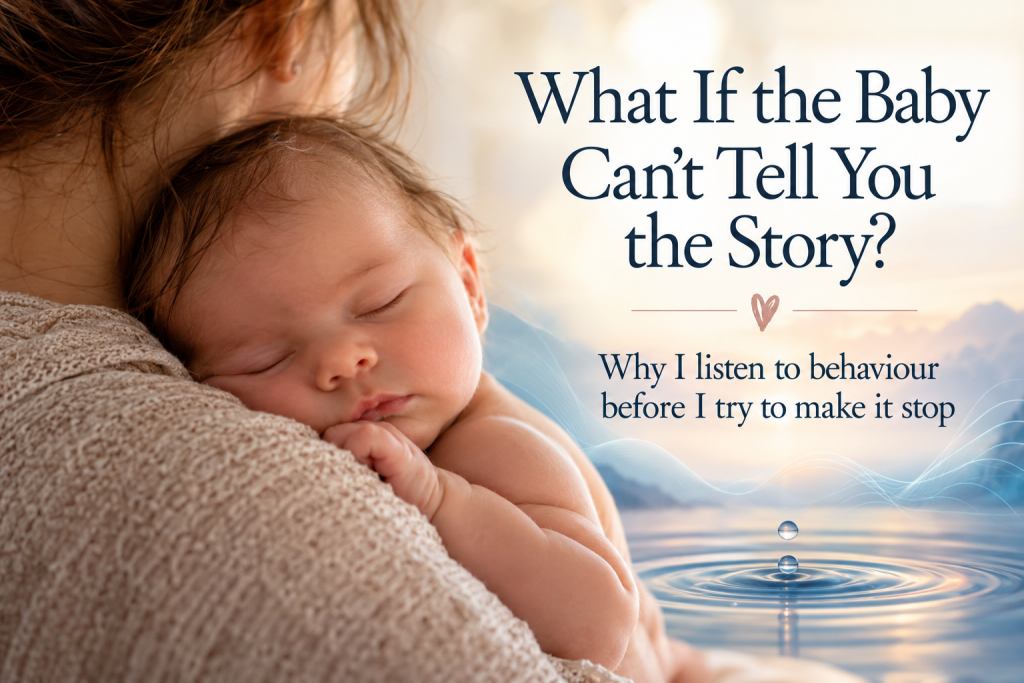
Why I listen to behaviour before I try to make it stop
By Joanne Yanke, BodyTalk Birthkeeper -Part 3 -October 2, 2026
There is a baby that almost every exhausted parent has fantasized about having.
It is the baby you can put down long enough to go pee, who happily lies on the mat while you make lunch, transfers effortlessly from your chest to the bassinet and somehow does not seem to notice that you have left the room.
Because that baby makes adult life easier, it is very easy for us to quietly turn ease into a developmental ideal. We call them a “good baby”: independent, content, easy to put down, easy to sleep and easy to hand to somebody else.
Then there is the baby who wants your body. They wake the moment you move, cry when somebody else holds them and somehow seem to know the exact moment your butt touches the mattress after you have spent twenty minutes trying to transfer them without waking them.
We jokingly call these babies “Velcro babies.”
I understand the joke, especially when you are exhausted and would really like the use of both arms for fifteen minutes, but I think we need to be careful about what problem we think we are solving.
Babies are supposed to need us.
Dependence Is Not Developmental Failure
Human babies are born profoundly dependent. They need nourishment, warmth, protection, touch and responsive caregiving, and their nervous systems develop within relationships.
The expectation of proximity is not a character defect. A baby wanting your arms is not manipulating you, and a nine-month-old who protests when you disappear is not running a sophisticated behavioural strategy designed to control your life.
Security does not develop because we successfully teach babies not to need us. It develops through enough experiences of connection, responsiveness, repair and safety that the child gradually becomes increasingly confident moving away from us.
This matters enormously in my infant sleep work because our culture so often begins with the adult goal. We want longer stretches of sleep, less feeding, less holding, less signalling and more time alone, and then we ask how to teach the baby to comply.
I prefer to begin somewhere else.
I want to know what the behaviour is communicating, what is developmentally normal for this age and what this particular baby seems to need. Then I want to ask whether there is anything about the response that feels bigger than the situation in front of us.
Because there is a difference between preference and panic.
There is a difference between a baby communicating, “I want you,” and a baby whose entire body appears to be saying, “Something terrible is going to happen if you leave.”
A baby protesting when you put them down may simply be behaving like a baby, and that deserves to be normalized rather than treated.
I have also worked with babies whose responses feel qualitatively different. There is the baby who would rather be held, and then there is the baby whose whole body seems to go into emergency when their caregiver moves a few feet away.
There is the baby who dislikes being strapped into a car seat, and then there is the baby I described in Part Two, who could sit calmly in his car seat until the seat was placed inside the car.
There is the child who approaches water cautiously, and then there is the baby whose response looks like genuine terror despite having no known frightening experience with water.
Those distinctions do not tell me why the response is happening. They simply tell me that there may be more worth listening to.
That is why I resist both extremes. I do not want to pathologize normal dependency, but I also do not want to dismiss every intense reaction as “just a phase” when a baby’s body seems to be communicating something much stronger.
Behaviour Is Communication
Before babies can tell us stories, they tell us things through their bodies.
They turn toward us and away from us. They stiffen, arch, freeze, startle and reach. They refuse, cling, settle in one person’s arms and become distressed in another’s. They respond differently depending on the environment, the position they are in, who is holding them and what happened immediately before.
None of those behaviours gives us a perfect translation.
I am very wary of the kind of thinking that says, “Your baby did X, therefore it means Y.” Human beings do not work like symbolic dictionaries, and babies certainly do not.
But behaviour gives us information.
One of the most useful shifts we can make is to become curious before we become corrective. Instead of beginning with, “How do I get them to stop?”, I want to know what changed immediately before the response happened.
Is it the restraint, or is it the car?
Is it water itself, or could it be the temperature, sound, position or sensation of being lowered away from Mum’s body?
Is the behaviour new? Could there be pain? Does it happen with everybody? Was there something similar during pregnancy or birth? What happens if we increase connection rather than decrease it?
And when it is appropriate to the family and the situation, I may also ask whether a BodyTalk session identifies another layer that none of us had considered.
That, to me, is listening.
This Is Where Active Memory Comes Back Into the Picture
In Part One, I described active memory as an experience or pattern that may be finished chronologically but remains active in the way the body-mind responds.
In an adult who can tell me what they are experiencing, that might look like a disproportionately powerful emotional or physical response to something happening in the present.
With a baby, we have fewer clues.
Perhaps there was something during pregnancy or birth. Perhaps an association developed after birth. The family may be living under enormous stress, there may have been a separation, or there may be a sensory challenge, developmental factor, feeding issue or physical discomfort. There may also be something medical that needs attention.
Within my BodyTalk framework, there may also be inherited, karmic or past-life material.
What matters is that I do not begin the session having already decided which explanation is correct. That would defeat the purpose of the work.
I follow what the system presents.
What I Mean When I Say a Past Life Comes Up in BodyTalk
One of the ways I think about our subconscious is as a vast library of experiences.
Every experience leaves something behind. Some of those “books” are easy to access because they are part of our conscious memory. Others sit much deeper on the shelf, outside our ordinary awareness.
A useful comparison is epigenetics.
You can carry a genetic predisposition without that gene ever being expressed. The information is there, but it may remain essentially unread unless something in the environment activates it.
I think about memory in a similar way.
Within my BodyTalk framework, our subconscious is continually scanning our library of previous experiences and asking, in effect, Have I been here before? What happened last time? How did I survive this?
Most of the time we are not consciously aware that this is happening. We simply experience the reaction.
Something happens in the present, an old “book” gets pulled from the shelf, and suddenly we are responding with far more fear, protection, anger, grief or physical tension than the current situation seems to require.
Sometimes the experience being pulled forward clearly belongs to this lifetime. It may connect with childhood, pregnancy, birth, trauma or something that happened only weeks ago.
Sometimes it appears to come through the family line.
And sometimes, within BodyTalk, the material is identified through our eighth-chakra or soul-memory work as belonging to another lifetime.
That is how I think about past-life material. I do not see it as randomly going searching for an interesting historical story. I see it as information that may have been sitting quietly in the library until something in the present activated it.
The present-day experience becomes the trigger that tells the subconscious, We have been here before. Pull that file.
The problem is that the response that was useful or necessary in another context may not fit this one.
That is often what I am seeing when a reaction feels much bigger than the present situation.
And sometimes the material that emerges does not seem to have originated with the person in this lifetime at all. It may appear ancestral, inherited or, within the BodyTalk framework, connected with soul memory or a past-life experience.
BodyTalk uses a structured protocol and neuromuscular feedback to follow those relationships within the body-mind. Sometimes what comes forward is remarkably specific. At other times, it is barely a story at all and may simply present as a theme such as loss, drowning, orphaning, separation, war, starvation, danger, being trapped or being rejected.
The purpose is not historical entertainment. I am not trying to discover whether you lived in France in 1742 because that would make an interesting conversation over coffee.
What matters to me as a practitioner is whether that information appears to be active now, whether it relates to the pattern we are seeing in the present, and whether anything changes when we work with it.
That last part is the important one.
I am less interested in proving where the book came from than in noticing why the subconscious pulled it off the shelf now.
Why Do We Tap?
People often ask me why BodyTalk uses tapping.
The way I understand it is simple: emotion is energy in motion.
When an emotional experience is fully felt, witnessed and integrated, it can move through us. But when it is overwhelming, interrupted, suppressed or never fully processed, that emotional energy can remain held in the body.
This is one of the foundations of somatic work. Our experiences do not only live in our thoughts. They can show up in tension, posture, breath, protective patterns, pain responses, startle responses and the ways our nervous system keeps reacting long after the original event is over.
I think of tapping as a way of helping something that has become stuck begin to move again.
The image I use is water.
Imagine a completely still puddle. If you touch the surface with your fingertips and begin tapping, ripples move outward. You have introduced movement into something that had become still.
That is how I think about what we are doing in BodyTalk. We identify the emotion, memory, belief or pattern that the system is holding, bring awareness to it, and then use tapping over the head and heart as part of the balancing process.
For me, the tapping is not about forcing the body to let something go. It is about giving the system an opportunity to process and reorganize what was never fully integrated in the first place.
Sometimes what has been held is recent. Sometimes it appears connected with birth, pregnancy, childhood, inherited family patterns or, within my BodyTalk framework, past-life material.
The common thread is that something still feels active in the body.
We bring it into awareness, introduce movement, and give the system another opportunity to complete what may have been interrupted.
That is the simplest way I understand tapping:
helping emotional energy that has become stuck begin to move again. Which can free up the body physically as well!
My Model of Consciousness Is an Ocean, Not a Row of Little Past Selves
This is how I make sense of past lives and soul memory.
I do not imagine Joanne being Joanne six hundred times in a row. This particular Joanne has never existed before. This exact combination of body, personality, history, relationships, children, work, circumstances and choices is unique.
The image that makes far more sense to me is an ocean.
An individual life is like a wave. It has a recognizable shape, location and identity. You can point to it and say, “There is that wave,” but the wave was never separate from the ocean.
It arose from the ocean, it is made of the ocean, and eventually its form dissolves back into it.
Then another wave arises.
It is not the same wave, but it comes from the same ocean.
That is how I understand consciousness.
Physics tells us that energy cannot be created or destroyed; it changes form. I think about our emotional memories and unresolved experiences in a similar way. They carry energy and information, and when an experience has not been fully witnessed or integrated, I do not believe that energy simply disappears because a lifetime ends.
In my work, I often encounter past-life material around traumatic or sudden deaths. That makes sense to me because there was no opportunity in that lifetime to process what happened. The person died in the middle of the fear, grief, terror, betrayal or helplessness.
The experience ended.
The energy did not.
Within the framework I work from, that unresolved material returns to the larger ocean of consciousness and can be carried forward until another lifetime gives it an opportunity to be activated, witnessed and resolved.
This is where the idea of soul memory makes sense to me.
We each carry a vast library of experiences, and when something happens in the present, the subconscious scans that library and asks: Have I been here before? How did I respond last time? What kept me safe?
Sometimes it pulls a memory from childhood.
Sometimes from birth.
Sometimes from the family line.
Sometimes from a soul memory that belongs to another lifetime.
And the response that gets activated may be completely out of proportion to what is actually happening now because it is not responding only to now. It is responding to everything that present experience has awakened.
That is also why I think so much about movement.
Emotion is energy in motion. When we allow an emotion to be witnessed and felt, it can move through us. I often describe it like standing at the edge of the ocean and letting a wave wash in and then recede.
The problem comes when we do not witness it.
We bury it.
We brace against it.
We get swept away in it.
Or we freeze around it.
Then what was meant to move becomes held.
That is how I understand emotional material becoming stuck in the body.
And that is why tapping makes sense to me.
Something that is still tends to stay still until something introduces movement. Something already in motion keeps moving until something changes its course.
When we tap, we are introducing movement into a pattern that has become fixed.
I often use the image of still water. Touch the surface and ripples begin moving outward.
That is what I believe we are doing when we identify an active memory and tap. We are helping the system move something that has been sitting there, waiting to be witnessed, processed and integrated.
For me, these ideas are not separate.
The ocean of consciousness, soul memory, active memory, emotion as energy in motion, and the way tapping helps create movement all belong to the same framework.
That is the framework I work from.
And after more than a decade of watching these patterns emerge in sessions, it is one that has become increasingly coherent to me.
Dolores Cannon Changed the Question for Me
One of the major catalysts for that shift was Dolores Cannon.
Reading The Convoluted Universe fundamentally expanded the range of questions I was willing to ask about consciousness. Cannon’s work emerged from decades of hypnosis sessions in which people reported past lives, between-life states and realities extending well beyond conventional understandings of a single human lifetime.
Her work changed what I was willing to consider possible and gave language to ideas that were already beginning to take shape through my own BodyTalk work.
Michael Talbot’s The Holographic Universe pushed those questions further, and over time I found the same themes appearing across prenatal consciousness, near-death experiences, children reporting previous lives and, most importantly for me, the material that kept emerging in sessions with my own clients.
And, importantly, I kept working with babies.
Over time, the boundaries around “this life begins here and ends there” stopped feeling quite as solid to me.
That is my worldview. I do not require every client to share it, but I am also not going to pretend I do not hold it simply because it would be easier to market a practitioner who stays comfortably inside familiar categories.
Science and soul do not have to be enemies. What they require from us is intellectual honesty about which one we are speaking from. Pasted markdown
What Changes When We See a Baby as Conscious?
For me, almost everything changes.
If I see a baby primarily as a collection of reflexes whose behaviour needs to be shaped, my question becomes, “How do I make this baby behave differently?”
If I see the baby as a developing human being participating in relationship from the beginning, I start asking, “What is this baby experiencing?”
If I allow for the possibility of consciousness before birth, the questions open further. I begin wondering what pregnancy was like for this baby, what birth communicated and what kind of relational environment the baby arrived into.
And if I am willing to hold consciousness before conception as a possibility rather than a proven fact, I may eventually wonder whether this baby arrived carrying something of their own.
None of that gives me permission to ignore physiology. Quite the opposite.
I still want to know whether the baby is hungry, in pain, overstimulated, ill, cold, hot, tired or moving through a developmental transition. I want to understand feeding, sleep, sensory processing, attachment, motor development and what is happening in the family.
Consciousness is not an excuse to abandon the body.
My work is called BodyTalk for a reason.
I want the whole picture: mind, body, relationship and baby.
The Goal Is Not to Make Babies More Convenient
This brings me right back to the Velcro baby.
If a baby needs closeness, my goal is not to “clear” their attachment to a parent so they become easier to put down. That would fundamentally misunderstand what I am doing.
There is nothing pathological about needing your caregiver.
Sometimes the most important intervention is helping an exhausted parent understand that their baby is not manipulating them, that dependence is not a failure, that holding them is not ruining them and that responding to them is not preventing future independence.
Sometimes, though, the amount of alarm tells us there may be another layer.
The baby’s nervous system may still be responding to something frightening about birth, there may have been a separation, a feeding problem may be causing discomfort, or the parent may be carrying enormous anxiety that the baby is responding to within the relationship. A family history of loss may have made separation especially charged across generations.
BodyTalk may take us into an active memory, or it may take us somewhere none of us would have predicted.
But the goal is not simply to make the baby easier.
Ultimately, my goal is to help these children stay connected to themselves, their truth, their autonomy and their agency.
I often joke that I am creating an army of invincible children.
There are children I have been working with since they were in the womb who are now eight or nine years old, and I have had the privilege of watching them grow up while continuing to work with them regularly.
These children have fears, of course. They are human.
But they also know who they are.
They are strong in themselves. They know what feels right and what does not. They are not easily talked out of their own truth, and they are not being trained to abandon themselves just to make the adults around them more comfortable.
They do not take anybody’s shit.
And I mean that in the best possible way.
Because these are the children I believe are going to change the world.
We talk so often about the idea that hurt people hurt people. I think the inverse matters just as much.
What happens when a generation of children grows up deeply seen, supported and connected to who they are?
What happens when they are taught, from the very beginning, that their feelings matter, their bodies matter, their boundaries matter and their inner knowing is worth listening to?
What happens when we support them in staying connected to themselves instead of training that connection out of them?
That is the work I care about.
Not making children more compliant.
Not making babies more convenient.
Helping them remain deeply connected to who they are, so they can grow into adults who do not have to spend decades trying to find their way back to themselves.
That is the kind of change I want to be part of.
Curiosity Is Not the Same Thing as Blame
This is especially important when we talk about prenatal experience, intergenerational patterns or parent-child regulation, because it is very easy for parents to hear accusation where I am actually trying to create understanding.
A mother may hear, “My stress harmed my baby,” “My birth caused this,” or “My trauma created the problem.”
That is not what I want women to hear from my work.
My own conception story is part of why.
I came into this life carrying the experience of being resented and unwanted, and that has shaped me deeply. It has also become part of the work I feel called to do.
I believe that I chose this life.
I believe I came here as a willing soul to do this work, and I do not think I would have the passion I have for healing these wounds if I had not experienced them myself.
I have done a lot of work around my own early experiences and the traumas that shaped me, including the Four Baskets work I have been doing around what I received, what I missed and what I learned about love, safety and belonging.
And I can honestly say that I feel gratitude now.
Not gratitude because painful experiences were pleasant or because they did not matter.
Gratitude because I can see what they awakened in me.
I chose to come into a story where I experienced what it feels like not to feel fully wanted, and now one of the deepest purposes of my work is making sure babies are seen, welcomed, connected with and consciously loved from the very beginning.
I never want a baby to feel the way I did.
That belief does not make my mother the villain in my story.
Quite the opposite.
The more healing I do, the more I can see my mother with compassion.
I can see that she had her own traumas, her own experiences and her own inherited patterns long before I arrived. I can see that she was shaped by what happened to her, just as her mother was shaped by what happened before her.
That is why I do not believe healing generational trauma is about identifying the bad guy.
It is about understanding the layers.
Our parents did the best they could with what they knew, what they had access to and who they were capable of being at that point in their lives.
That does not mean everything they did was harmless.
It means we can hold both truth and compassion at the same time.
We can acknowledge that something hurt us without reducing the person who hurt us to that one thing.
We can understand why a mother could not show up in the way her child needed without pretending the child did not feel the absence.
I am seeing this very directly in my work right now with a pregnant woman, her little girl and her mother as they begin healing a generational pattern together.
The grandmother is able to look back at what was happening in her own life when she was raising her daughter and acknowledge why she could not show up the way she wishes she had.
There is regret there.
There is pain.
There is also responsibility, love and understanding.
That is where healing becomes possible.
Not because somebody has been blamed, but because something that was hidden can finally be seen.
That is the entire point for me.
We are not here to shame our mothers, fathers or grandparents.
We are here to reveal what is still active so that it can finally be healed instead of replayed again and again.
A pregnant woman does not choose every stressor around her. She may be grieving, unsupported, living through medical trauma or trying to function under impossible circumstances. She may be carrying patterns that were handed to her by her own parents while simply trying to survive the circumstances she is in.
Awareness is useful only when it gives us more options.
If a pattern was learned, it can change. If connection was interrupted, it can be rebuilt. If something was never fully witnessed or processed, we can return to it now. If an old story is still active, it does not have to remain active forever.
That is the hopeful part of all of this.
And this matters before conception too.
A woman preparing to welcome a baby may already be thinking about the kind of emotional environment she wants to create, the family patterns she wants to end and what she wants to leave behind before becoming a mother.
I do not want her to hear that as one more demand to become completely healed before she is allowed to conceive.
There is no finish line where you finally become perfect enough for motherhood.
The invitation is to become more conscious of what you are carrying, more connected to yourself and more able to recognize when an old pattern is driving the present.
That is very different from perfection.
It is how a pattern stops being inherited unconsciously and starts becoming something we can actually choose to change.
The Point Is Not to Have All the Answers
There are enormous questions underneath everything I have written in this series.
Where does consciousness begin? What do we carry into this life? How much of what we feel belongs to our own lived experience, how much has travelled through our family systems, and how much may come from somewhere older than either?
I expect I will keep exploring those questions for the rest of my life.
But I do not need to have every answer before I can listen differently.
That, more than anything, is what this work has taught me.
When a baby cries, resists, clings, freezes, panics or reacts in a way that seems much bigger than the moment in front of us, I do not want my first question to be, “How do we make this stop?”
I want to ask, What is this baby telling us?
Sometimes the answer will be beautifully ordinary. They are hungry. They are tired. They need their mother. They are overstimulated. They are in pain. They are going through a developmental transition and need more support.
Sometimes the story will take us into pregnancy or birth.
Sometimes it will take us into the relationship around the baby, into the family system or into something that has been carried for generations.
And sometimes, in my work, it takes us somewhere much older.
I do not see any of those possibilities as reasons to fear what we may find.
I see them as opportunities to understand.
Because once something can be seen, it no longer has to keep operating invisibly.
Once a mother can recognize the pattern she inherited, she has an opportunity to stop handing it forward. Once an old emotional experience can finally be witnessed, it has an opportunity to move. Once a baby’s behaviour is understood as communication rather than inconvenience, we can respond to the baby instead of simply trying to extinguish the signal.
That is what makes this work so hopeful to me.
I think about the children I have had the privilege of working with since they were still in the womb, some of whom are eight or nine years old now. They are not children who never struggle or never feel afraid.
They are children who know themselves.
They know when something does not feel right. They trust their own experience. They have a sense that their bodies, feelings, boundaries and inner knowing matter.
I jokingly call them my army of invincible children, but there is something very serious underneath that joke.
We often say that hurt people hurt people.
So I cannot help wondering what happens when more children grow up deeply seen instead.
What happens when they are supported in staying connected to themselves rather than spending their childhood learning to disconnect in order to belong?
What happens when their fear is met with curiosity, their boundaries are respected, their emotional experiences are allowed to move and their truth is taken seriously?
What kind of adults do those children become?
What kind of parents?
What kind of partners, leaders and people in the world?
That is ultimately why this matters so much to me.
My work is not about making babies quieter, easier, more independent or more convenient for adults.
It is about protecting that connection to self before the world teaches them to abandon it.
It is about helping parents understand what their babies may be communicating, helping old patterns stop where they can stop, and giving children the greatest possible opportunity to grow up knowing who they are.
I came into this life with my own wounds around being wanted, belonging and receiving. I have spent years understanding them, healing them and recognizing the generations of stories surrounding them.
I do not wish that story away anymore.
It gave me this work.
It gave me a profound respect for the experience of the baby, including the baby who cannot yet tell us what happened.
And it gave me a very simple conviction:
Babies deserve to be listened to before they have words.
That is what sits underneath my fertility work, my pregnancy work, my birth work, my infant sleep work and my BodyTalk practice.
Your BodyTalks. Your baby does too.
My work is helping you listen.